Peloponnese Itinerary for 7 Days: Ancient Greece Road Trip

Most people who plan their first visit to Greece always tend to include Athens and a few islands first. I always knew I definitely had to visit Athens the first time I visit, but then to rent a car and drive through the Peloponnese to see all the ancient sites that one can possibly see in a few days. The moment we crossed the Corinth Canal I knew this trip would be one of the best ones I had in my travel life. Peloponnese is such a great and beautiful part of Greece, but also very overlooked. If you’re looking to visit, here you will find my Peloponnese itinerary for 7 days.
This itinerary will include ancient sites and Byzantine sites, but also small coastal towns and some hidden gems. The places included in this itinerary are: Corinth, Olympia, Kardamyli, Sparta, Mystras, Mycenea, Epidaurus and Nafplion.
✅ If you’re looking for a custom travel plan, find out more about my personalised itinerary service here.

Heads up! Some links in this blog are affiliates. If you click and buy, I may earn a small commission at no extra cost to you. Rest assured, I only recommend stuff I’ve tested or trust. You can read more about our affiliate disclaimer here.
Short on time? Here are my top recommendations:
HOTELS:
- Pegasus Rooms Corinth
- Prytanio Olympia
- Ifigenia’s Rooms Kardamyli
- Lakonia Hotel Sparta
- Harmony Hotel Nafplio
ACTIVITIES:
Travel Resources for Greece:
📖 Read my Is Peloponnese Worth Visiting? And Why I Loved It blog post.
How to Get to Peloponnese
To get to Peloponnese the best is to fly to Athens International Airport.
✅ Check the flight prices here.
Once you’re in Athens, then you’d definitely need to rent a car to reach Peloponnese and explore it properly.
📖 Read my Athens Airport Guide (And How I Almost Missed My Flight) blog post.
How to Get around Peloponnese
There are limited guided tours, and these are mostly day trips to the nearest places like Corinth, Mycenea, Nafplion and Epidaurus.
Personally, this is too much to fit in one day, so if you’re looking to really venture into Peloponnese and actually spend some time there, then renting a car is inevitable.

Where to Stay in Peloponnese
Firstly, let me say that the Peloponnese is a larger peninsula, so you can’t really stay in one place only. Me and my husband changed 5 different hotels in 7 days, and while it can seem inconvenient, it was not. When you’re with a car, things are definitely easier, especially travelling with luggage.
If you’d be following this exact Peloponese 7 days itinerary, then you’d need to stay in Corinth, Olympia, Kardamyli, Sparta or Mystras and Nafplion (like I did).
💡I will mention below places where we stayed personally, apart from Corinth because we had a negative experience there where we didn’t get a suite we booked and paid for as they rented it to someone else! Instead we got a cheaper double room with no views! This hotel no longer seems to appear on Booking, but it was called Apollonio Suite, so keep away from it. Instead, I will recommend the next place I would book if I knew this would be the case.
Here are my personal hotel recommendations for Peloponnese:
- Corinth: Pegasus Rooms – great location; near the ancient site
- Olympia: Prytanio – great location & breakfast
- Kardamyli: Ifigenia’s Rooms – great location & wonderful owner
- Sparta: Lakonia Hotel – great location
- Nafplion: Harmony Hotel Nafplio – amazing views

When to Visit Peloponnese
I visited off season, from mid to late October and it was a great decision. The days were mostly nice and warm, and at times we needed summer clothes. But there were no crowds at all, so it was a really pleasant way to experience Peloponnese.
Summer can be great too if you want to do some sightseeing in the morning and then spend the rest of the day at the beach.
Winters are a bit colder and it rains more compared to the rest of the year, but it’s still better than Northern Europe in winter months.
Personally, if your goal is to sightsee as much as possible and spend a lot of time at ancient sites, then it’s probably better to visit in spring or autumn, especially if you can’t bear the summer heat.

How Many Days in Peloponnese is Ideal
As you can see, there are even guided day trips from Athens, but I wouldn’t personally do it, unless you’ve already checked some places in Peloponnese and you have a day extra in Athens to see something new.
Otherwise, to really experience the Peloponnese Peninsula properly, I definitely recommend at least 7 days because that way you’d be able to check the most important places and make a circle around the region.
The ideal amount of time would be 2 weeks, but even with a week less you can see some of the best places in the Peloponnese without feeling rushed.
📖 Read my What Should You Not Miss in Peloponnese? 8 Places I Loved blog post.
Google Maps of Peloponnese 7 Days Road Trip Itinerary
Day 1 in Peloponnese: Corinth
Corinth is the first place in the Peloponnese, so it makes sense to start from here.
✅ You can explore Corinth on your own or on this Ancient Corinth Private Tour from Corinth.
Corinth Canal
The idea of Corinth Canal already started with Ancient Greeks, but the first construction finally began in the 1st century AD under the Roman Emperor Nero, however the project ceased shortly after his death. There were a few other attempts over the centuries, but nothing concrete was accomplished.
Finally, the construction began in 1881 and was completed 2 years later. Unfortunately, the Corinth Canal failed to attract the level of intended traffic and today it’s basically a tourist attraction only.
Still, I was quite happy to see it in person, so definitely don’t skip it. It’s still a fascinating place.
The best place for photos is on the Old Isthmia Bridge. Additionally, I recommend having coffee at Isthmia Bridge Cafe. It’s a great place to soak up the views and breathe the Peloponnese air.

Acrocorinth
The place that I didn’t expect much from, but completely blew me away was Acrocorinth.
Acrocorinth was the acropolis of ancient Corinth and it’s surely the most impressive acropolis of mainland Greece I have ever seen.
Firstly, it’s the highest acropolis I’ve personally visited – it’s 575 m (1886 ft) above sea level!
Second, it’s huge – the wall is about 3 km (61 acres) long.
So, the main mistake that we made was coming to Acrocorinth 1.5h before closing time – it closes around 4 pm depending on the season, which is quite early in my opinion.
Basically, we didn’t dedicate enough time to it, but we still managed to see quite a lot. I definitely recommend coming here first thing in the morning and spending at least 3h there.
Just note that the site is completely free to visit (another thing that shocked us!), but that also means that there are no workers nor cafes around (beside one at the entrance), so bring a lot of water and snacks if you plan on spending more time there.
Additionally, wear comfortable shoes because no entrance fee also means no proper looking after the place, so some parts are quite difficult to walk on as they’re in ruins.
While Acrocorinth was built in Ancient Greece times, it was further expanded by Byzantines, Franks and Ottomans, until it was completely abandoned after the 19th century earthquake.
I don’t need to say that all the way the views are breathtaking.
Acrocorinth was one of my favourite places on this whole road trip through the Peloponnese – don’t skip it!
Most important sights to see at Acrocorinth:
- Gates
- Agios Dimitrios Church
- Mosque
- Frankish Tower
- Peirene Spring
- Temple of Aphrodite
- Walls
My favourite sights at Acrocorinth were Gates, Frankish Tower, Walls and obviously the views.

Gates Frankish Tower Walls Views of Corinth


Ancient Corinth
Ancient Corinth was one of the largest and most important cities of Greece. Later, Romans overtook and rebuilt the city.
Corinth was also an important city for development of Christianity because the Apostle Paul came here to preach and convert Gentiles. He also wrote at least two epistles to the Christian church, known as the First Epistle to the Corinthians and the Second Epistle to the Corinthians.
Sadly, not much has left of the ancient city, but the archaeological site is definitely worth exploring. Certainly, it was a great intro to other ancient sites we would explore in the Peloponnese region.
You can easily buy tickets on the spot.
Most important sights to see at Ancient Corinth:
- Temple of Apollo
- Temple E
- South Stoa
- Roman Forum
- Peirene Fountain
My favourite sights at Ancient Corinth were the Temple of Apollo and Peirene Fountain.
Temple of Apollo Peirene Fountain


Day 2 in Peloponnese: Olympia
Olympia is the birthplace of the Olympic Games – the first one were played exactly on this spot in 776 BC!
Besides that, Olympia is also a place of one of the Seven World Wonders of the Ancient World – Statue of Zeus. The statue was about 12.4 m (41 ft) tall and was made of ivory plates and gold panels.
Sadly, nothing has survived of the statue today, but there are still ruins of the Temple of Zeus where the statue was held. To me and my husband, even seeing those ruins was enough because we knew we were standing at a place of this once magnificent structure and wonder.
✅ You can visit Olympia on your own and get tickets on the spot or on this private guided tour.
For a unique experience, you can also book this Famous VR Glasses Tour to imagine how Olympia once looked like when it was in its full glory.
Most important sights to see at Olympia:
- Stadium
- Temple of Zeus
- Gymansion
- Palaistra
- Philippeion
P. S. Don’t skip the adjacent museum where they keep statues and other artefacts from the site.
My favourite sights at Olympia were Stadium, Temple of Zeus and Philippeion.
Stadium Temple of Zeus Philippeion


Day 3 in Peloponnese: Kardamyli
I’ve never heard of Kardamyli before, not until I watched Rick Steve’s episode on Peloponnese. Instantly when I saw it, I knew I had to visit this cute little gem in what is called the Mani Peninsula.
Once in Kardamyli I learnt who the Mani people are – basically clans of the 16th century which formed into patriarchal groups linked by blood ties.
They were an autonomous society, which is why they built walled cities in Byzantine styles to defend themselves, especially from Ottoman Turks. They unified with the rest of Greece in the 19th century.
So, it’s not surprising that you will find Byzantine architecture in Kardamyli, which is what gives it a unique style and why I loved it so much. It’s one of my favourite places on this Peloponnese road trip.

Kardamyli Old Town
The best and most beautiful and historical part of Kardamyli is of course its Old Town, which is a fortified complex from the 17th and 18th centuries.
You’d need to pay for an entrance and you can easily do it on the spot. We enjoyed sightseeing because it was for most of the time empty, with maybe a couple of other tourists that we run into every now and then.
Most important sights to see at Kardamyli Old Town:
- The Church of Ayios Spyridon
- Tower House
- Tower
- Museum

Agia Sofia Church
Agia Sofia Church is one of the most beautiful Orthodox churches in the Mani Peninsula. It’s on a hill above Kardamyli, so you’d need to either drive there or hike.
Even though we had a car, we wanted to hike. It took us 20 minutes per way, and while it wasn’t the easiest hike, it also wasn’t that bad, so I would definitely recommend it to you too if you’re in a good physical condition. If you decide to hike, bring water as there are no shops next to the church. Also, wear comfortable shoes.
Agia Sofia Church is famous for its frescoes, but sadly it was closed when we came. I’m not sure if it’s a permanent thing or if we may have arrived at a wrong time, but even so, it was worth coming as it’s a really cute church + the views towards the church were really amazing.
We were for most of the time the only ones there, so it was such a peaceful and serene experience.

Seaside Cafes & Restaurants
Kardamyli is a popular seaside spot in the Mani Peninsula, so most of the restaurants and cafes are next to the sea.
Our favourite was Aquarella Cafe where we came several times during our 24h visit.

Day 4 in Peloponnese: Sparta & Mystras
Before visiting Sparta, I read all over the places that it’s not worth going there, that there’s nothing left to see.
But as a Historian, I just couldn’t not go! So, I decided that I will visit even if there’s only one stone to be seen.
And I don’t know if it’s because I have expected little from Sparta, but it was awesome! All those people who are saying to you not to visit, don’t know what they’re saying. Obviously, the archaeological site is not as impressive as others you’d see on this trip, but there’re definitely things to see + the further excavations are undertaking. Plus, the modern city of Sparta had such a cool and local vibe, though it’s not pretty at all.
Besides Sparta, we also visited Mystras, a well-preserved Byzantine city next to Sparta. This one blew me away!

Leonida’s Statue
If you’ve ever watched the movie 300, you know that the most famous Spartan was Leonidas I who led the allied Greek forces in a last stand at the Battle of Thermopylae against the Persian Empire under Xerxes I.
The modern city of Sparta commemorates the legend of Leonidas, which is why you’ll find his statue on your way towards the ancient site of Sparta.

Archaeological Site of Sparta
The Archaeological Site of Sparta is actually way better preserved than people are giving the credit to it.
But I got personally excited when I saw the team of archaeologists currently excavating and renovating the theatre, which was the first time when I saw somebody at work at a historical site!
I can only imagine that this place would look much different in the upcoming years and decades as further excavations are undertaken.
In terms of the tickets, it is free to visit the site which surprised me a bit.
Most important sights to see at Ancient Sparta:
- Agora
- Theatre
- Round Building
- Roman Stoa
- St Nikon’s Basilica
- Two-Niched Building
- Sanctuary of Athena Chalkioikos

Cenotaph of Leonidas
The Cenotaph of Leonidas is the only preserved monument from the ancient Agora, dating back to 5th century BC.
It is believed that Leonidas was buried there, though it hasn’t been proven yet. It was still a cool place to check!

Archaeological Museum of Sparta
Once you’ve visited the ancient site of Sparta, I recommend checking the Archaeological Museum of Sparta.
The museum is rather small and doesn’t really justify the ticket price, but there’s a hoplite statue found within the site that was given the name Leonidas as it’s believed that he looked like that.
You can buy tickets at the entrance.

Mystras
When ancient Sparta was ruined and abandoned, a new fortified town was formed on a hill above ancient Sparta – Mystras.
Mystras was a Byzantine town which was inhabited until the 19th century when the modern city of Sparta was built and the people moved down there. Today, some people still live in a modern village of Mystras which is slightly below the Byzantine archaeological site.
Honestly, this place blew me away! I read there are many monasteries and a castle within the site, but I never expected Mystras to be so huge – basically we couldn’t even finish the sightseeing because after 3h we were exhausted, though we managed to see most of the sites.
All these buildings have been abandoned, apart from Pantanassa Monastery which is still inhabited by nuns.
There are 2 entrances, but if you’re with a car, I definitely recommend driving to the upper entrance first to see the Castle, Holy Church of Hagia Sophia and the Church of Agios Nikolaos.
When you’re done with that part, then drive to the lower entrance to explore Metropolitan Church, Pantanassa Monastery and other nearby churches.
You can get tickets at either of the entrances, just don’t throw it away when you’re done with the first part.
Most important sights to see at Mystras:
- Castle
- Holy Church of Hagia Sophia
- Church of Agios Nikolaos
- Metropolitan Church
- Pantanassa Monastery
- Church of the Hodegetria
- Church of Hagioi Theodoroi
My favourite sights at Mystras were the Castle, Holy Church of Hagia Sophia and Metropolitan Church.
Castle Holy Church of Hagia Sophia Metropolitan Church


Day 5 in Peloponnese: Mycenae
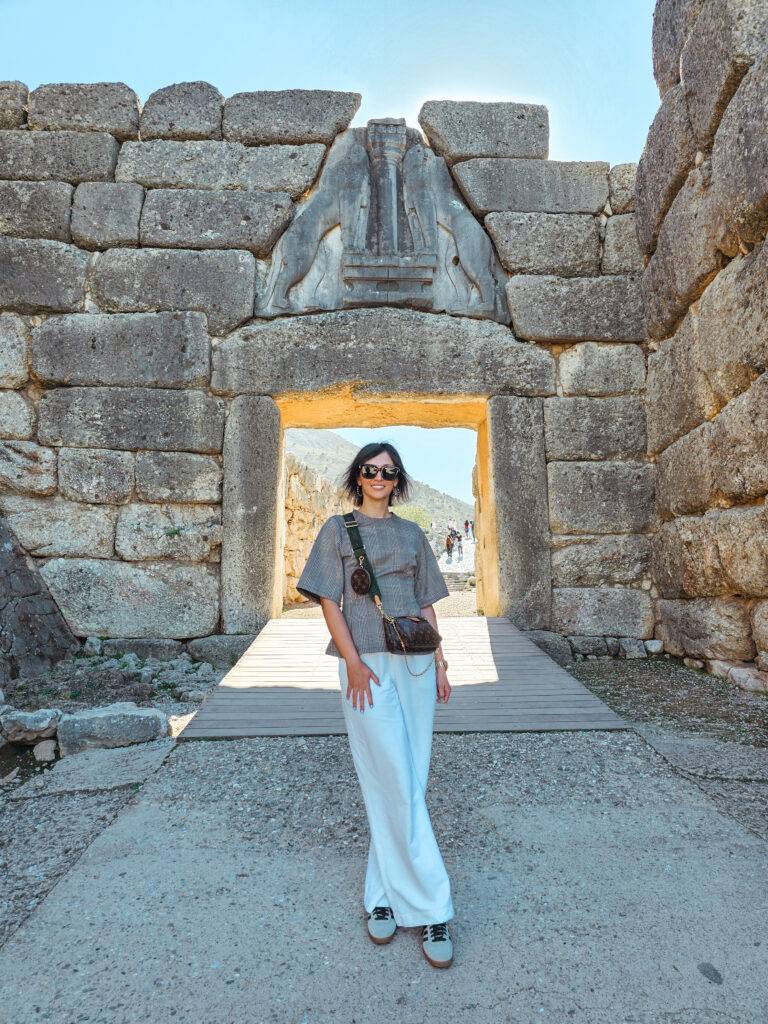
Mycenae was the highlight of my Peloponnese itinerary!
When I visited Egypt and saw the pyramids and temples, I thought I would never again see anything like it that would impress me as much – oh boy, was I wrong!
I knew everything about Mycenae before arriving there, but I never expected the site to be that big, and I surely didn’t expect that Agamemnon’s tomb would give me Egyptian vibes.
We spent 2 hours at the site, so there’s definitely plenty to see and read about. You can buy tickets at the site.
✅ Mycenae is one of the easiest day trips from Athens, so you can also visit on a guided tour.
Most important sights to see at Mycenae:
- Lion Gate
- Agamemnon’s Tomb
- Granary
- Grave Circle A
- Chambers
- Propylon of the Palace
- Palace
- Underground Cistern
- Lion Tholos Tomb
- Museum
My favourite sights at Mycenae were Lion’s Gate, Agamemnon’s Tomb and Underground Cistern.
Lion Gate Agamemnon’s Tomb Underground Cistern


Day 6 in Peloponnese: Epidaurus
Epidaurus will be the last ancient site on this 7 days Peloponnese itinerary.
What makes Epidaurus different from other sites is that it was a Sanctuary of Asklepios, god of medicine. It was the most important healing centre in the Ancient Greek world.
It’s not a surprise that the sanctuary and theatre of Epidaurus were enlisted in the UNESCO World Heritage Site.
I really loved Epidaurus, it’s such a great site to visit and it was among my favourites! The theatre was quite impressive and very similar to the one in Ephesus in Turkey, though a bit smaller.
You can buy tickets on the site or visit on a guided tour.
Most important sights to see at Epidaurus:
- Theatre
- Katagogion
- Stadium
- Temple of Artemis
- Stoa of Abaton
- Tholos
- Museum
My favourite sights at Epidaurus were Theatre, Stadium and Stoa of Abaton.
Theatre Stadium Stoa of Abaton


Day 7 in Peloponnese: Nafplion
And we’ve come to the last day of this Peloponnese 7 days itinerary, which is reserved for Nafplion.
I totally fell in love with the city and it’s a place where I would definitely love to come for summer holidays.
✅ Consider taking this best rated Nafplion City Walking Tour.
Palamidi Fortress
Palamidi Fortress is a Venetian fortress built in the 17th century when Nafplion was under their rule. It was later conquered by the Ottomans in the 18th century.
Needless to say, it is the best sight in Nafplion and I definitely recommend visiting. If you’re with a car, then you can drive to the top, which is what we did, otherwise you need to climb around 900 steps to reach the fortress.
There are several bastions you can explore and from each the views are amazing, especially from Bastion of Themistocles.
You can buy tickets on the spot.


Akronafplia’s Castle
Akronafplia’s Castle is the oldest castle in Nafplion, built and expanded by Romans, Franks, Venetians and Ottomans.
We wanted to visit, but we left it for later in the day, however, it was closing already around 4 pm, so we realised we wouldn’t have time for it. If you’d love to visit, then maybe it’s better to start with it.

Bourtzi Fortress
Bourtzi Fortress is another Venetian fortress in Nafplion built in the 15th century when Nafplion was under their rule.
You can take a boat tour to the fortress, but you can also see it from the port and promenade.

Promenade
The Promenade is a great place to enjoy the sea views, people watching and having a drink.
We went several times to Noa Verde Nafplio because the atmosphere was great.

Karathona Beach
At this point I regretted not bringing our swimming suits because I thought there’s no way we could swim in Greece in late October – I was wrong.
On the day we were exploring Nafplion, we had summer daytime temperatures and the sea temperature was around 25 C (77 F), which is definitely warm enough to swim. Some people were smart and were doing exactly that.
The best part was that because it was the low season, the beach was almost empty, so you could really enjoy it. Lesson learnt – so from now on I will always pack a swimming suit when travelling around the Mediterranean because you never know!
The beach is sandy with beautiful turquoise sea, it’s definitely a great spot for summer time.

Is Peloponnese worth Visiting
As I said in my intro, whoever is visiting Greece, especially for the first time, they always tend to flock to the islands. Even people who have been to Greece several times may have never explored the Peloponnese region.
What a mistake!
Peloponnese is one of the most ancient parts of Greece – with Athens it’s where the western history was shaped.
The region is full of ancient sites and ruins, Byzantine architecture, amazing food and beautiful nature. I wish I had a month to explore everything I wanted to see and spend more time in places that I fell in love with.
With the upcoming Odyssey movie, I am sure Peloponnese would be put on the travel map and it’s a matter of time this underrated region gains on popularity.
If you’re thinking whether to visit or not, I urge you to do it now before it’s spoiled with mass tourism, which I hope would never happen.
Yes, the Peloponnese is very much worth visiting!
Read my other Greece blog posts:
✅ If you’re looking for a custom travel plan, find out more about my personalised itinerary service here.
Like this post? Pin it!📍